Cash Transfers and Girls’ Education: What the Evidence from Mali Tells Us
For many girls in Mali, the dream of an education remains fragile.
Across the central regions of Mali—Mopti, Bandiagara, and Ségou— conflict, economic instability, and entrenched gender norms often prevent girls from staying in school. While national enrolment rates have improved, the transition from primary to secondary school remains a critical challenge: 80% of girls do not complete secondary education.
At this critical stage, many girls leave school due to financial pressure, domestic responsibilities, or early marriage.
To help address these challenges, WUSC, with funding from Global Affairs Canada (GAC), implemented an education program in Mali, a five-year initiative that worked to reduce barriers to girls’ education in conflict-affected regions by providing financial support, improving school environments, and engaging communities to support girls’ continued learning.
The education program focuses on the final years of primary education—when girls are most at risk of dropping out—and uses a holistic, conflict-sensitive approach. By supporting girls, families, communities, and schools at the same time, the program helps make staying in schools a realistic and achievable choice.
A recent evaluation of the program’s Conditional Cash Transfer (CCT) component offers important lessons about what works, what doesn’t, and what it truly takes to support girls’ education.
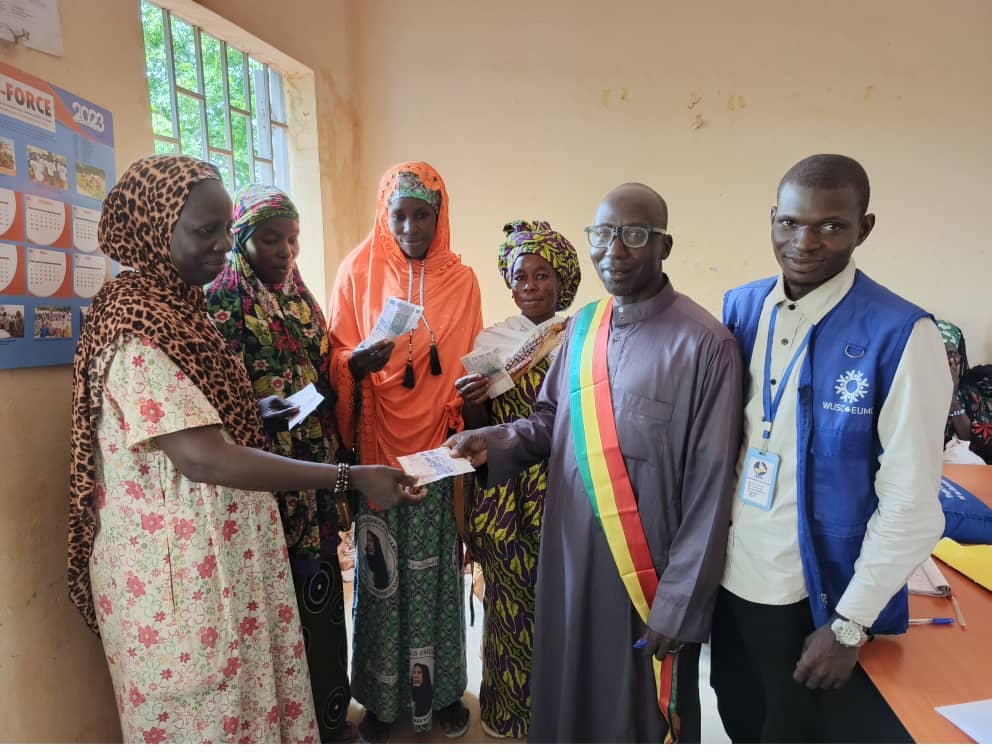
Distribution of cash transfers to mothers receiving support, in the presence of the Deputy Mayor of Boidié and Soungola, Ségou region, in Mali.
Why Cash Transfers Matter
For many families, the right to an education is constrained by financial realities.
Even when tuition is free, the costs of school supplies, transportation, uniforms, tutoring, and daily expenses quickly add up. At the same time, girls are often expected to contribute to household work, income-generating activities, or marriage arrangements.
The program’s cash transfers were designed to ease this pressure by providing regular financial support to vulnerable households—specifically through women—to help families prioritize their daughters’ education.
As one parent explained:
“The money provided by the program for girls’ education has been a great help to us. We are able to pay their school fees, give them pocket money for recess, buy them shoes and other basic needs. We are even able to save a little to buy goats.” – Fatoumata, parent.
But financial support alone is not enough. What matters most is how that support changes decisions, confidence, and opportunity.
What the Evaluation found
The results were both encouraging and nuanced.
1. Cash Changes Household Behaviour
Families receiving cash transfers invested more in their daughters’ education—particularly in tutoring and after-school support.
Girls’ education became an active investment.
However, the impact was not equal across households. Smaller families, and those with higher literacy levels were often better able to turn financial support into stronger educational gains.
This highlights an important lesson: the most vulnerable families may need additional, tailored support beyond cash alone. “Today, we have realized the importance of girls’ education. When they succeed, they can become a great support for their parents.”– Ouou, parent.
2. Confidence Was the Biggest Early Win
One of the most powerful findings was not about grades—it was about confidence.
- 95% of girls reported feeling confident in their ability to succeed.
- Half of them directly linked this confidence to the cash transfers.
- Parents reported that girls were more motivated, engaged, and committed to their studies.
For many girls, financial support created both stability and possibility.
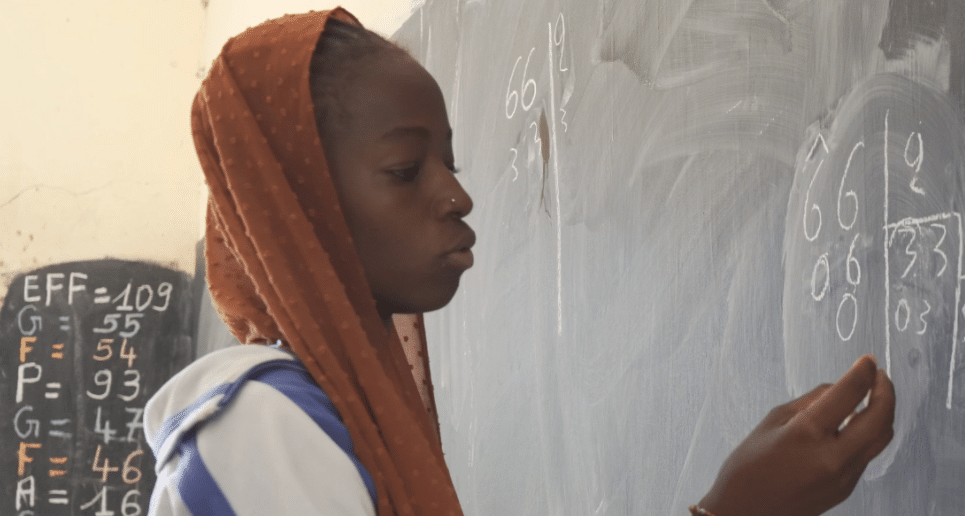
Student Aminata L. Ballayira from Soungola village writing on the classroom board.
“I used to live in my village where school ended at Grade 6, which forced me to stop my studies. At that time, all students stopped in Grade 6 with no possibility to continue. Thanks to the program, my parents were sensitized and understood the importance of education, which allowed me to resume my schooling. To continue secondary school, we had to move to Boidi, and our parents agreed to rent a house here so we could continue.”– Aminata, adolescent girl.
Cash transfers can do more than remove financial barriers—they can help girls believe in their own future.
3. Access Improves, but Learning Requires More
Despite these positive findings, the evaluation found no significant difference in enrolment or retention rates between girls who received cash transfers and those who did not, nor was there a strong direct link between cash transfers and improved literacy outcomes.
This points to a critical insight: financial support alone cannot solve challenges related to teaching quality, learning environments, or broader social norms.
Real progress happens when financial support is combined with community engagement and strong school support.
For some girls, this combined approach made all the difference. “My parents had arranged my marriage, which put a stop to my studies. Thanks to the program, my teachers took the time to speak with my parents, who understood the situation. They then spoke to my future in-laws, who also agreed. Today, I am continuing my studies. After finishing school, I want to become a doctor to treat people in my village.”– Aoua, adolescent girl.
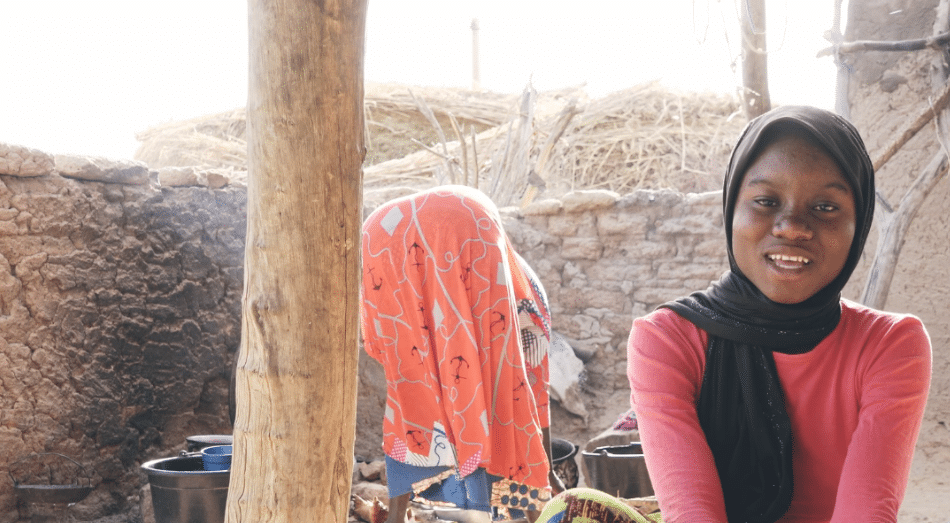
Student Aoua, a cash transfer recipient from Kamba village in the Ségou region in Mali.
What Drives Success
The evaluation also highlighted the importance of how the program is delivered:
- Community-led targeting built trust and legitimacy.
- Strong coordination between WUSC, local partners, and payment agents improved efficiency, timeliness, and accountability in delivery.
- Clear communication kept families informed and engaged.
Challenges That Remain
- Demand still exceeds supply, leaving many vulnerable families unsupported.
- Travel costs and low literacy makes accessing payments difficult for some households.
- Limited formal feedback systems mean not all voices are equally heard.
These gaps show that improving girls’ education requires long-term, system-wide investment.
The Biggest Takeaway: Cash Transfers are a Starting Point
Cash transfers are powerful.
They reduce immediate financial barriers, boost motivation and confidence, and help families prioritize girls’ education.
But cash transfers alone are not the solution.
Supporting girls’ education requires a broader, integrated approach—one that combines financial support with stronger schools, engaged communities, and sustained family support.
Because when girls stay in school, they gain more than an education—they gain choices, confidence, and the power to shape their own futures.
Learn more by reading the full technical evaluation or summary, and support our work to help more girls access the education they deserve.